
What Homeowners in the Midwest Deal With That Others Don’t
What makes Midwest homeownership different isn’t just the weather; it’s how problems develop rarely all at once, and almost always over time.
You notice it in small ways at first. A garage door that hesitates slightly during a cold morning. A system that feels tighter than it did the night before. A door that still works, but not with the same ease it had just a few months ago. None of it feels urgent, which is exactly why it’s easy to ignore.
But in regions like Northeast Ohio, those subtle changes are rarely random. Most home maintenance issues here aren’t caused by one season—they’re caused by all of them working together. Cold, heat, moisture, and constant transition don’t just wear systems down. They gradually shift how everything fits, moves, and performs.
And over time, that shift becomes the defining challenge of Midwest homeownership.
It’s Not One Season—It’s All of Them
In many parts of the country, home maintenance revolves around a primary environmental factor. In the Southeast, it’s heat and humidity. In the Southwest, it’s dryness and sun exposure. In coastal regions, it’s salt air and storms.
In the Midwest, there isn’t just one force. There’s constant transition.
A home in Northeast Ohio can move from freezing temperatures in January to humid heat in July, then back again within the same year. Materials don’t simply endure one condition—they cycle through expansion, contraction, drying, and reabsorption over and over again. These cycles don’t cancel each other out. They compound.
For homeowners in areas like Solon and Aurora, that means nothing stays perfectly aligned for long. Systems that felt smooth in one season can feel slightly off in the next, not because something has failed, but because the environment has subtly reshaped how everything works together.
Small Shifts Add Up Quickly
One of the most defining characteristics of Midwest homeownership is how problems develop. They rarely appear suddenly or dramatically. Instead, they build slowly, often blending into the background of everyday life.
A door may not close quite as smoothly. A system may feel slightly heavier during colder months. A structure may settle just enough over time to affect how different components interact. These changes are easy to overlook because everything still functions, and daily routines aren’t interrupted.
But those small shifts don’t stay isolated. In regions like Northeast Ohio, where homes are constantly adjusting to seasonal changes, minor misalignments begin to influence performance more quickly than in stable climates. What starts as a subtle inconvenience can gradually create strain across multiple parts of a system, especially when colder conditions amplify the effect.
This is where Midwest maintenance feels different. It’s not about reacting to a single event. It’s about understanding how small changes evolve over time.
The Garage Door Is a Perfect Example
Few systems highlight this pattern more clearly than a garage door. It’s one of the most frequently used parts of the home and one of the most exposed to outdoor conditions, making it especially sensitive to environmental change.
In the Midwest, garage doors operate through both extremes—cold, brittle winters and warm, humid summers—while maintaining precise balance and alignment. That constant fluctuation creates a type of wear that doesn’t always show up as failure, but instead appears as subtle changes in performance.
A door may hesitate slightly in the cold, then feel smoother again in warmer weather. It may develop a faint vibration or a shift in sound that doesn’t seem urgent—the kind of change most homeowners notice but can’t quite explain. These are not isolated issues. They are early indicators of a system adjusting to repeated stress.
Across Northeast Ohio, this kind of wear tends to show up well before anything actually fails. For companies like Ohio Garage Door Repair, it’s a familiar pattern—what seems like a sudden issue is often the result of a system gradually falling out of balance, only becoming noticeable as seasonal conditions shift.
Older Homes, Different Challenges
Another factor that sets Midwest homeownership apart is the age and diversity of its housing stock. In communities like Aurora and surrounding areas, it’s common to see a mix of newer construction alongside homes that have been standing for decades.
Older homes bring character, but they also carry a history of adjustments. Foundations settle, additions are made, and systems are updated over time. These changes subtly alter how different parts of the home interact, especially when layered over years of seasonal movement.
A garage door system that was once perfectly aligned may now be operating within a structure that has shifted slightly. Clearances change, angles adjust, and components begin to compensate. The system still works, but it does so under conditions that are no longer exactly what it was designed for.
That long-term environmental impact is something experienced professionals pay close attention to. Maxim Geht of Ohio Garage Door Repair notes that this kind of wear is often tied to what he describes as the “history” of a system. “In a place like Aurora, we might see a 20-year-old door that has survived 80 seasonal transitions. That metal has expanded and contracted thousands of times. It’s not just about the age of the part; it’s about the ‘mileage’ the environment has put on it. Reliability comes from knowing how to calibrate for that history.”
Newer homes present a different challenge. Larger doors, higher ceilings, and modern layouts require precise calibration to maintain consistent performance. These systems are built for scale, but they still respond to the same environmental pressures that define the region.
Maintenance Is Less About Fixing—and More About Watching
In more stable climates, maintenance is often reactive. Something breaks, and it gets fixed. In the Midwest, the approach becomes more observational.
Homeowners learn to notice patterns rather than isolated problems. They recognize when something feels slightly off, even if it still works. They pay attention to changes in sound, movement, and timing, especially during seasonal transitions when systems are under the most stress.
This awareness becomes especially important for systems that rely on balance and repeated motion. A garage door that hesitates during winter isn’t simply reacting to the cold—it’s often revealing a small shift that has been developing over time and is now being amplified by the environment.
This doesn’t require more work. It requires better timing. Addressing small changes early prevents larger disruptions later, especially in a region where those changes are inevitable.
The Midwest Warning Signs
For homeowners in this region, certain patterns show up often enough to be recognized. They don’t always signal immediate failure, but they do indicate that something is changing beneath the surface.
- The “Seasonal Stick”: A door that closes smoothly in humid summer conditions but stops just short during dry winter months, often pointing to alignment changes caused by contraction.
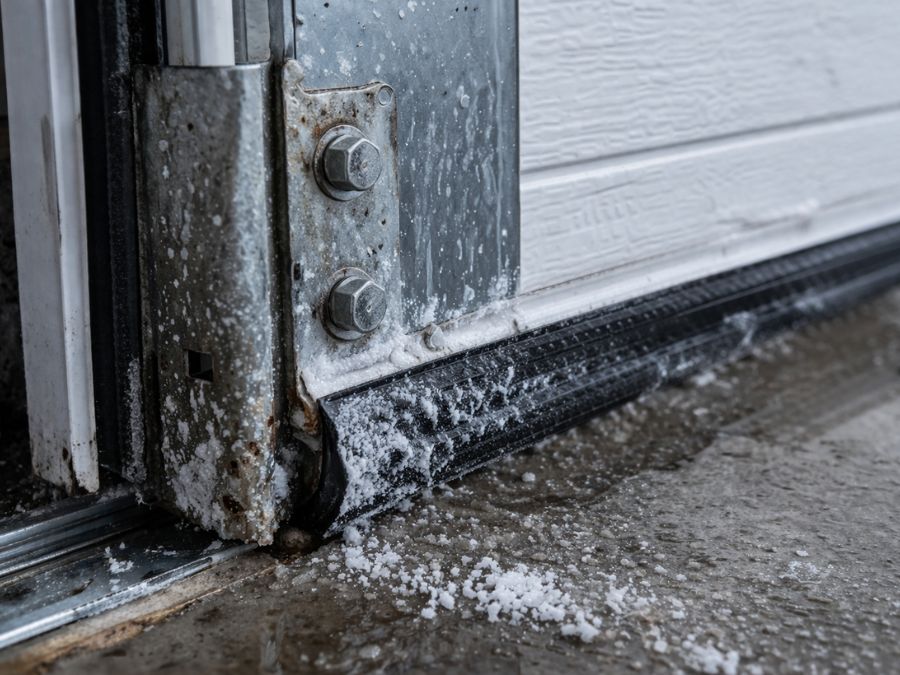
- The “Salt Scuff”: Discoloration or wear along the bottom portion of tracks or hardware, typically from road salt exposure beginning to affect the steel.
- The “Phantom Reverse”: A door that opens without issue but refuses to close properly when temperatures drop, often tied to sensor shifts or slight track contraction.
These signs are subtle, but in the Midwest, they are rarely random.
A Different Kind of Wear
What makes Midwest homeownership unique isn’t just the conditions themselves. It’s how those conditions interact across seasons.
Cold doesn’t act alone. It follows warmth and humidity. Heat doesn’t simply expand materials—it builds on months of contraction and exposure to moisture. Each season adds another layer of stress, gradually shaping how systems perform over time.
Because of this, problems rarely feel dramatic at first. They develop in stages, often blending into the background until something shifts enough to demand attention. By the time that happens, the issue is usually not new—it’s the result of accumulated change.
What Homeowners Learn Over Time
Spend enough time owning a home in the Midwest, and your perspective begins to shift. You stop expecting things to stay perfectly aligned and start understanding that change is part of the process.
You begin to notice how systems feel, not just whether they work. You recognize subtle differences in movement, sound, and responsiveness. And over time, you learn that consistency matters more than perfection when it comes to long-term performance.
This mindset doesn’t eliminate problems, but it changes how they’re handled. By recognizing patterns early, homeowners are better positioned to address issues before they become disruptive.
A Different Standard of Living With Your Home
Homes in the Midwest are not static. They are constantly adjusting to the environment around them, responding to seasonal shifts in ways that influence how every system performs.
The homeowners who manage that reality best are not the ones who avoid problems altogether. They are the ones who understand that change is inevitable and learn to work with it.
Because in the Midwest, the homes that hold up best aren’t the ones that stay the same.
They’re the ones maintained with change in mind.
